La Vache Enragee
I grew up in a house filled with art. Not like a museum filled with priceless masterpieces and not like a mansion with its history staring down from the walls— instead it was prints mostly, small images behind the dinner table or hanging in the living room. Everything exactly in its place. I hardly noticed them when I was growing up; it was just there like the table, and the chairs, and the cats.
I noticed when they were gone though. Not at first, since my dorm rooms were small, cluttered, and I covered the walls with posters in a way that I had never done at home. The transience of dorm rooms means that they resist becoming yours; you do not so much reside in them as stay, like an extended visit at a half star hotel. The rules remind you of this, they say what tape you can use, what kind of hooks can be attached to what walls. The allowed supplies are never good enough. Posters peel and hooks holding up picture frames fail in the middle of the night. I still owe Sewanee fees for damage some tape did to the walls of my senior year dorm.
But at least you are allowed, briefly, to try to own the space. This is not always true. I spent a summer working in Lincoln, Nebraska, a place I have little fondness for. The worst part was not the sweltering heat, the dull work, or even the endless, rolling boredom, it was the walls of the apartment building I lived in. They were gray, and we were not allowed to cover them.
This gray was a very special gray. It was completely non-committal, not especially dark, not light. In fact, it seemed to suck in the light and it was everywhere. Every hallway, every room, it would seep into my dreams fading the other colors like paint remover. And I could not cover it.
It has been a while since I lived in Lincoln. I haven’t stepped in a dorm room since I left my senior year. In grad school I lived with roommates, and could only cover the walls of own room, but I did that much. The posters went away, and I put up prints. Gifts mostly, but I found money to fill any holes so everything could have a proper place.
Prints are the most democratic form of visual art. A single plate or set of wood blocks can become numerous works, each numbered and marked. In some cases after the original run new reprintings can be run so that the next generation can partake. Art for everyone.
There has always been something attractively democratic about printing in general; in many ways it is the mirror image of the democratic process. In an election many voters come together to create a single government. In printing a single design, plate, or screen is used create many copies. And while museums house incredible exhibits of breathtaking work, they stop at their own doors and cannot and should not fill my apartment with beauty. You will probably never have a Van Gogh hanging in your bedroom, but you can have a Toulouse Lautrec reprint. Trust me, I do.
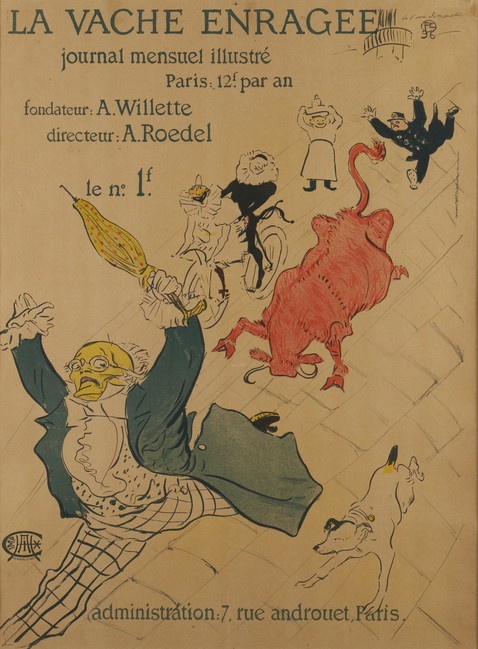
La Vache Enragee
It is one of my favorites, La Vache Enragee, it was a gift from my father. It is genuinely funny. Every time I look at it I always see the same thing first; a balding man with skin the color of the street fleeing down the avenue, checkered pants clashing with the cobblestones, long green coat billowing behind him, and his hands, raised up in surrender, holding a distinctly feminine umbrella. Behind him is a bull. He is red, his head is down, and his horns are up. Around them there are others, a policeman, a baker, a dog, a clown and a monkey riding the bike, but they are probably bystanders.
Not that they have to be. A challenge of visual art is that nothing says you can’t tell a story, only that you have a single frame. But if you only have a single frame you can provide infinite possibilities. Sometimes I look at that print and see the obvious, the angry bull and the fleeing, rich fool. But sometimes I am more interested in the baker. Is he really just a bystander? Does he know more than his happy smile would suggest? Sometimes I see the dog, maybe about to pounce on the fool. Or maybe just running along side because what fun this is.
I love that print. And I love that it hangs from a nail that no one could tell me not put there. And I love that every time I look at it and tell a new story that story sinks down that nail into the wall. And then that story, my story, seeps into the wood, the bones of the apartment, and this place becomes a little more mine.